The Software I Use
and Where It’s Made
April 10, 2025 · Software · 26 likes
What is it about?
I’ve listed all software and services that I currently use on regular basis (as of March 2025), added where they are from and if they are open source. Inspired by /uses pages on other personal websites1.
But why?
As a member of a (capitalist) society, one of the key ways you influence its structure is by making choices about the products you consume/purchase. When it comes to groceries, I already pay (some) attention to the origin of food products and whether they are sourced locally or from the other side of the globe. However, I’ve realized that in the digital space in which I spend a lot of time and in which my daily work takes place, I haven’t given it much thought until now. I have the feeling that, especially in the current times when the CEOs of large tech companies are not taking a political stance or following power-hungry autocrat, it makes more sense than ever before to think about the origin of the digital products that we use every day.
But it is important to say, that I do not want to make a blanket statement that software that comes from the US, Russia or China is worse or more morally reprehensible than software that comes from Europe, for example. In this overview I primarily want to get an idea from which countries the software comes from and what the ratio is. This way, I (hopefully) can make better decisions about whether I feel safe sharing my sensitive data with them or giving them my money and attention.
What I use
I’ve listed all the software I regularly use on both desktop (MacOS) and mobile (iOS) and tried to organize them into different categories.
Development
| Software | Description | Location | Open Source |
|---|---|---|---|
| VSCode | IDE of my choice | 🇺🇸 USA – Redmond | ✅2 |
| Zed | new IDE I’m currently trying out | 🇺🇸 USA – San Francisco | ✅ |
| Hyper | Electron-based terminal emulator | 🇺🇸 USA – San Francisco | ✅ |
| Docker | Containerization platform | 🇺🇸 USA – Palo Alto | ✅ |
Design/Photography
| Software | Description | Location | Open Source |
|---|---|---|---|
| Figma | Design tool for mainly everything | 🇺🇸 USA – San Francisco | ❌ |
| Adobe Lightroom | Photo editing + organisation | 🇺🇸 USA – San Jose | ❌ |
| Affinity Designer | Design tool for vector stuff | 🇬🇧 UK – Nottingham | ❌ |
| Inkscape | Vector Design tool to control my pen plotter | 🌍 Community-driven | ✅ |
| Eagle | Digital asset and inspiration manager | 🇹🇼 Taiwan | ❌ |
Media/Social media
| Software | Description | Location | Open Source |
|---|---|---|---|
| Mastodon | decentralized social network | 🇩🇪 Germany – Jena | ✅ |
| Tidal | Music streaming | 🇳🇴 Norway – Oslo3 | ❌ |
| Pocket Casts | Podcast player | 🇺🇸 USA – San Francisco | ✅ |
| Reeder | RSS reader | 🇨🇭 Switzerland | ❌ |
Communication
| Software | Description | Location | Open Source |
|---|---|---|---|
| Slack | chat for work | 🇺🇸 USA – San Francisco | ❌ |
| Discord | communities | 🇺🇸 USA – San Francisco | ❌ |
| Signal | preferred private chat | 🇺🇸 USA – Mountain View | ✅ |
| private chat I want to ditch | 🇺🇸 USA – Menlo Park | ❌ | |
| Telegram | private chat I want to ditch | 🇦🇪 UAE – Dubai4 | ❌ |
Organisation/Notes
| Software | Description | Location | Open Source |
|---|---|---|---|
| Obsidian | Markdown note taking tool | 🇨🇦 Canada5 | ❌ |
| Apple Mail | mail client | 🇺🇸 USA – Cupertino | ❌ |
| Apple Calendar | calendar client | 🇺🇸 USA – Cupertino | ❌ |
| Raindrop | Bookmark manager | 🇰🇿 Kazakhstan | ❌ |
General/Misc
| Software | Description | Location | Open Source |
|---|---|---|---|
| Zen Browser | Current browser of my choice (firefox fork) | - | ✅ |
| Raycast | Mac OS spotlight alternative | 🇬🇧 UK – Cheshire | ❌ |
| MoneyMoney | Personal finance management app | 🇩🇪 Germany – Düsseldorf | ❌ |
| 1Password | Password manager | 🇨🇦 Canada – Toronto | ❌ |
| Yoink | Drag-and-drop file manager | 🇦🇹 Austria – Vienna | ❌ |
| CleanShot | Tool for making screenshots/screen recordings | 🇵🇱 Poland | ❌ |
| Synology Drive | File syncing and sharing solution for my Synology NAS | 🇹🇼 Taiwan – Taipei | ❌ |
| Backblaze | Cloud backup service for all my NAS data | 🇺🇸 USA – San Mateo | - |
| Strava | Tracking app for cycling and running | 🇺🇸 USA – San Francisco | - |
The ratio
My conclusion
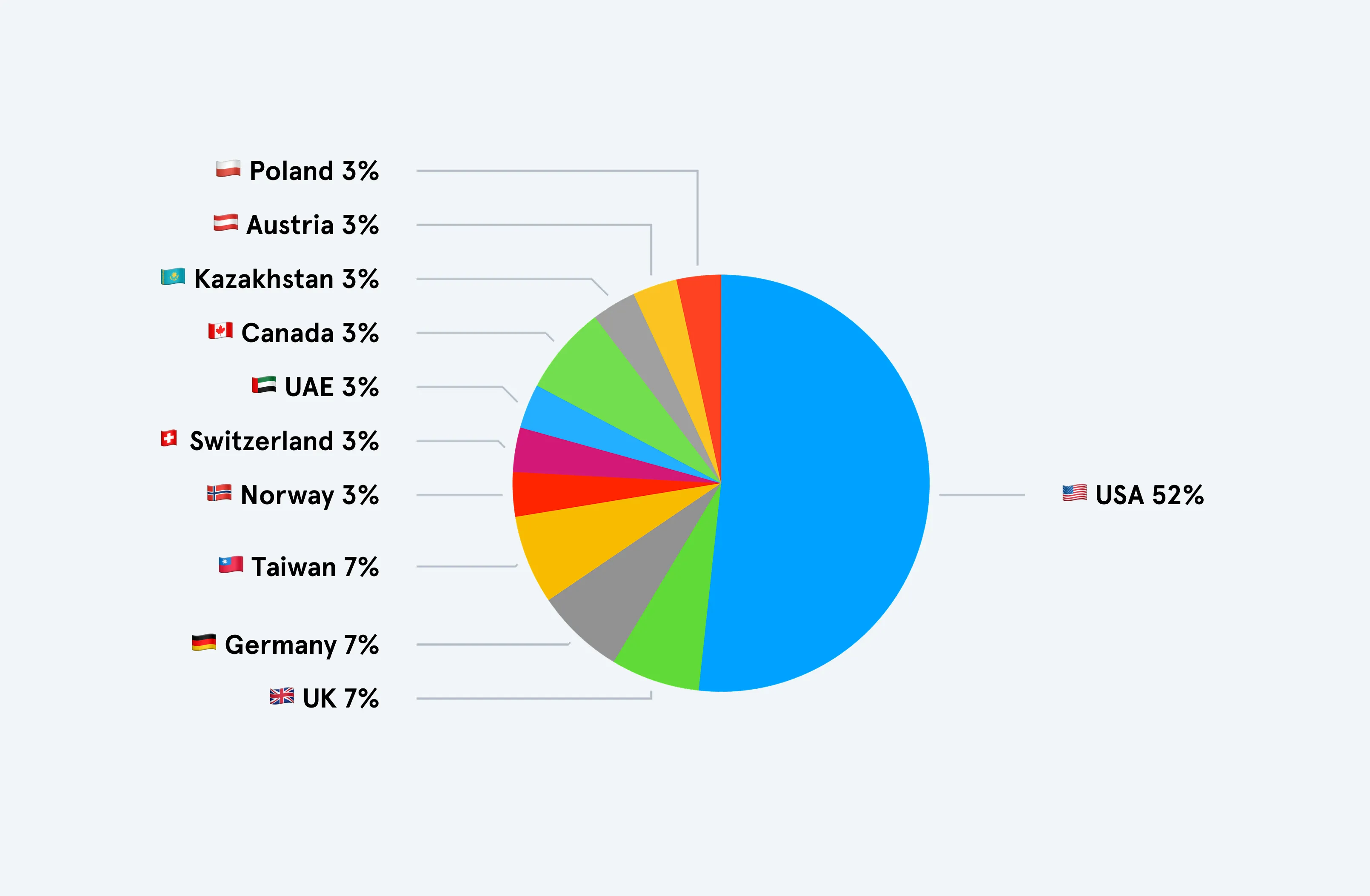
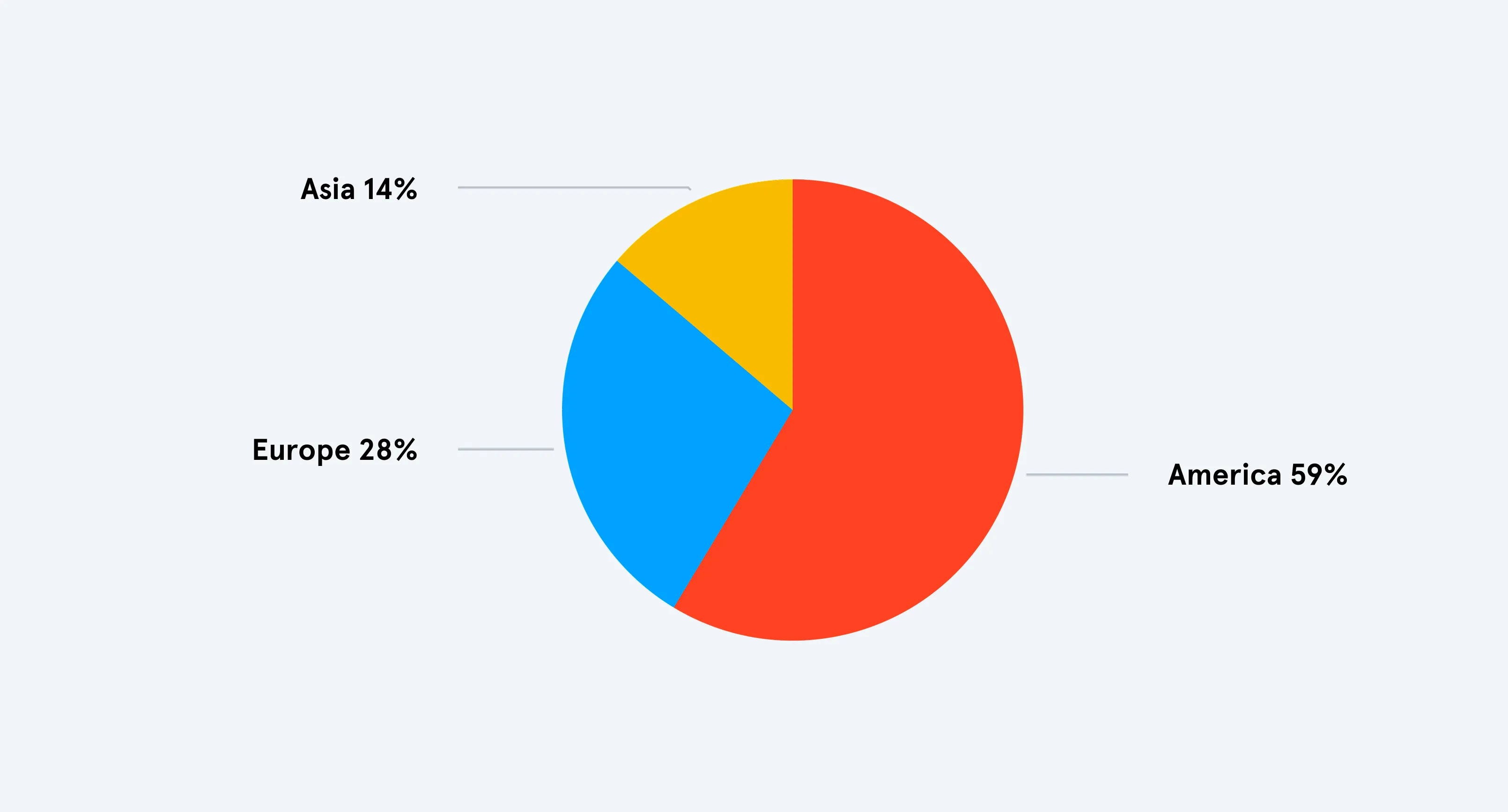
There isn’t a clear conclusion — at least not one that leads to immediate action. While it’s striking that 52% of the software I use comes from the US, I’m pleasantly surprised by the variety of countries represented.
Still, two patterns stand out and give me pause:
First, every piece of software I rely on professionally to earn a living as a developer comes from the US. As far as I know, there are no serious alternatives that wouldn’t disrupt my workflow and significantly reduce my productivity.
Second, I’m uneasy about the origins of the communication tools I use daily. I’d prefer European alternatives due to their stronger data protection laws, but, as with social media platforms, getting people to switch is difficult. Familiarity and widespread adoption keep users locked into existing services, making it hard to transition to what might actually be a better option.
Perhaps this blog post encourages you to take a moment to consider where the software you use every day comes from and what impact that has — especially when it comes to data privacy. The choices we make, even when they seem small, shape the digital world we rely on.
Footnotes
-
I love exploring /uses pages on personal websites and always find it fascinating to see what tools others rely on. It’s a great way to discover new software I might not have known about. A great collection of such pages can be found at uses.tech. ↩
-
The core of VS Code is open source and is licensed under the MIT license. However, the official version released by Microsoft contains proprietary elements, such as extensions and branding. ↩
-
TIDAL was founded in Norway by Aspiro but later acquired by a group of artists led by Jay-Z. Today, it is majority-owned by Block, Inc. (USA), though its origins remain Norwegian. ↩
-
Telegram is officially headquartered in Dubai, but its origins trace back to Russia. Over the years, the company has relocated multiple times, primarily due to regulatory and privacy concerns. ↩
-
Obsidian is developed by Dynalist Inc., a company based in Canada. ↩
Replies (11)
Vil@kwalm
Very interesting article! Is there a RSS feed for the new blog? I'm just able to find the RSS feed of the 365 project.
Robin· me
Thanks, glad you like it! RSS is on the list, but I wanted to deploy it first before I get carried away with more features I have in mind 😄
Jeroen@JeroenSchaper@mastodon.design
Nice! No task manager app?
Robin· me
part of my obsidian daily note setup :)
Oliver Brux@oliverbrux
Ich versuche gerade Figma durch Sketch 🇳🇱 zu ersetzen. Ich weiß, hört sich an wie eine Rolle rückwärts aber das neue Layout Feature schaut ganz vielversprechend aus.
Robin· me
ich spiele auch schon seit längerem mit dem Gedanken mir Sketch mal wieder anzuschauen! Wäre aktuell aber leider nur in privaten Projekten möglich – für die Arbeit bin ich auf Figma angewiesen. Wie sind deine ersten Eindrücke?
Bisher ganz gut. Das neue Layout Feature ist sehr gut. Gibt es aber nur in der Beta. Das Plug-In Universum ist kleiner. Dafür eine native App, was ich sehr angenehm finde. Klare Preise. Aber keine kostenlose Variante wie bei Figma mit drafts.
Ich hatte auch mal Penpot ausprobiert aber da störte mich, dass ich alles nur online habe und Schriften nicht lokal erkannt werden, sondern individuell importiert werden müssen.Robin· me
klingt eigentlich ganz vielversprechend. Vor allem weil mir figma mittlerweile fast zu viele Features hat die ich gar nicht brauche und es mir schwer fällt am Ball zu bleiben.
Werde mir mal die 30 Tage Probe laden und schauen wie es mir gefällt :)
Eike Drescher@eikedrescher@mastodon.design
nice post! A way to increase the european share would be to give my podcast app Queue a try :)
David@fossil12
Nice post and overview. The Pocket Casts clients are open source: github.com/Automattic/pocket-c…
Robin· me
Oh thanks for the hint! Changed ✅
10 more replies over there. Join in on Mastodon ↗